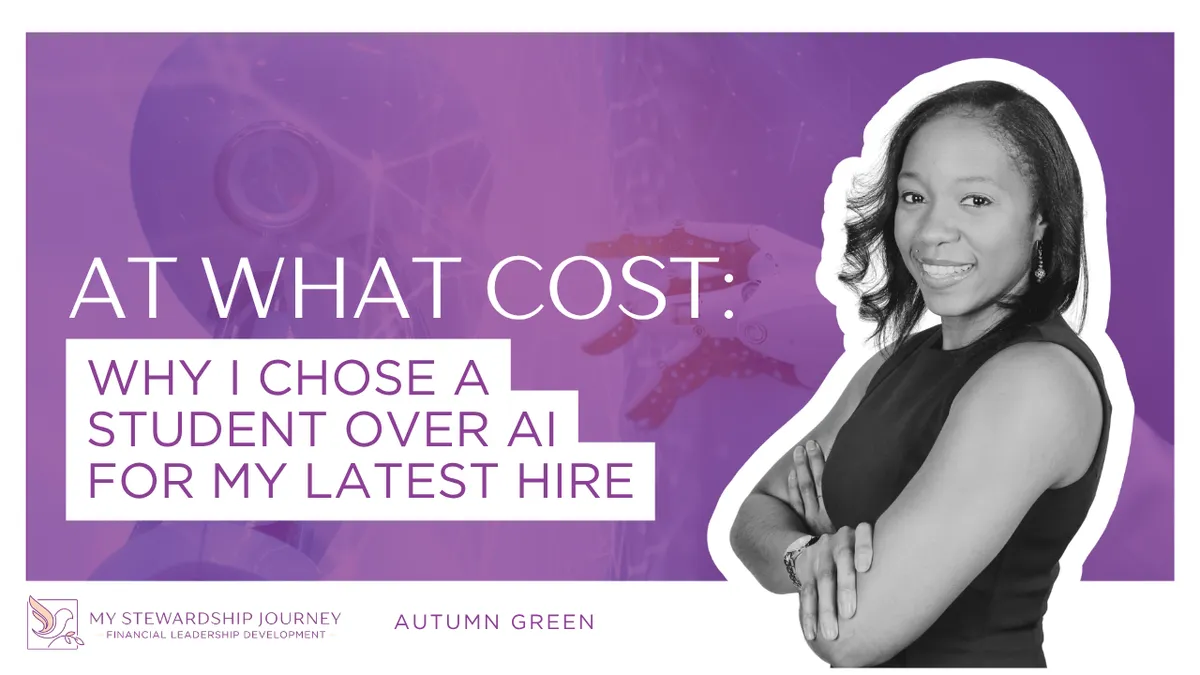
At What Cost? Why I Chose a Student Over AI for My Latest Hire
I am currently hiring an Operations Lead for our programs. It’s an entry-level position the kind of role where someone manages breakout rooms, keeps strict time, analyzes cohort feedback, and ensures our live sessions run seamlessly.
As I was building out the role, a thought crossed my mind: I could easily set up an automated script, run a few timers myself, and download an AI tool to do 90% of this work for free.
Let me be clear right up front: I am no AI expert. I use AI in my business, and I believe technology is an incredible leverage tool. But as I sat looking at the specs for this role, my spirit told me to stop.
Instead of automating the position to save a few dollars, I decided to hire a high school or college student.
Why? Because I value human connection, and I care deeply about the pipeline of the next generation.
We are living in an era where businesses are rushing to replace entry-level tasks with software in the name of efficiency and cost-cutting. But we need to stop and ask a dangerous question: At what cost?
Robbing the Next Generation of the Starting Line
If every company automates its entry-level roles, where do young people learn how to work? Where do they build foundational skills like time management, operational execution, professional communication, and crisis control?
Corporate America has already created a ridiculous bottleneck by demanding "3 to 5 years of experience" for entry-level positions right out of undergrad. If a student spent their college years grinding through their studies and didn’t have the bandwidth for three internships, how are they supposed to get that experience if we replace every baseline job with a bot?
I think back to my own journey. Early on, I had a job filing paper medical records at Mount Sinai on the Upper East Side in New York. Was filing papers the most complex task in the world? No. But that entry-level opportunity taught me accountability, operational discipline, and how to navigate professional environments.
If the leaders before me had taken an "all-or-nothing" approach to cost-cutting, I wouldn't have had the playground I needed to build my skills. We cannot rob young people of the starting line and then criticize them for not knowing how to run the race.
Money is a Tool for Connection, Not Just Hoarding
You might think a topic like hiring entry-level staff has nothing to do with personal finance, but it has everything to do with how we steward wealth.
People will go to extreme, unnatural lengths to save a dollar. They will cut human beings out of their ecosystem, eliminate customer service, and isolate their operations just to keep their profit margins slightly wider.
But money is not the end goal; money is a tool meant to leverage your quality of life. And a high quality of life inherently includes community, human connection, and pouring into the ecosystem around you.
What is the point of making or saving massive amounts of money if the system you build is cold, robotic, and isolated? What good is "efficiency" if it leaves your community worse off than you found it?
3 Thoughts
If you are a business owner, executive, or leader navigating this tech boom, here is how you stay human while staying profitable:
1. Distinguish Efficiency from Impact
AI is phenomenal for backend data processing, baseline drafting, and administrative heavy lifting. But it cannot offer empathy, real-time human encouragement, or genuine connection. Do not trade high-impact human touchpoints for cheap automation.
2. Preserve the On-Ramp
Look at your organization's hiring structure. Are you creating intentional, low-risk opportunities for high school and college students to gain real-world experience? If you have simple operational tasks, turn them into paid learning opportunities rather than software subscriptions.
3. Measure Value Beyond the Spreadsheet
Financial stewardship isn't just about minimizing expenses to absolute zero. It’s about directing your dollars toward things that create net-positive value in the world. Paying a student a fair wage to manage your operations returns value directly into your community while building your business’s future talent pipeline.
The Bottom Line
I am not anti-AI. But I am fiercely pro-human.
Before you replace another human role with a tool just to save a quick buck, look at the big picture. Protect your early-talent pipeline. Give young people an opportunity to learn, fail, and grow under your leadership.
Real wealth isn't just a high bank balance it’s the strength of the community you build along the way.
Ready to Lead Your Money with Purpose?
True financial mastery isn't about stingy hoarding; it's about building a bulletproof operating system that gives you the freedom to invest in and spend on what actually matters. Check out our Know Your Numbers course today to start stewarding your resources with total clarity and intention.
Ready to Make Your Money Work for What Matters Most?
Financial success is about more than growing your bank balance. It’s about making intentional decisions with your money, building a strong financial foundation, and creating the freedom to invest in the people and priorities that matter most.
At The Stewardship Journey, we help you understand your numbers, make confident financial decisions, and build a financial strategy aligned with your goals and values.
Ready to take the next step toward financial freedom?
Explore our services to discover how we can help you steward your money with greater clarity, confidence, and purpose.
Explore our services: https://www.thestewardshipjourney.com/services