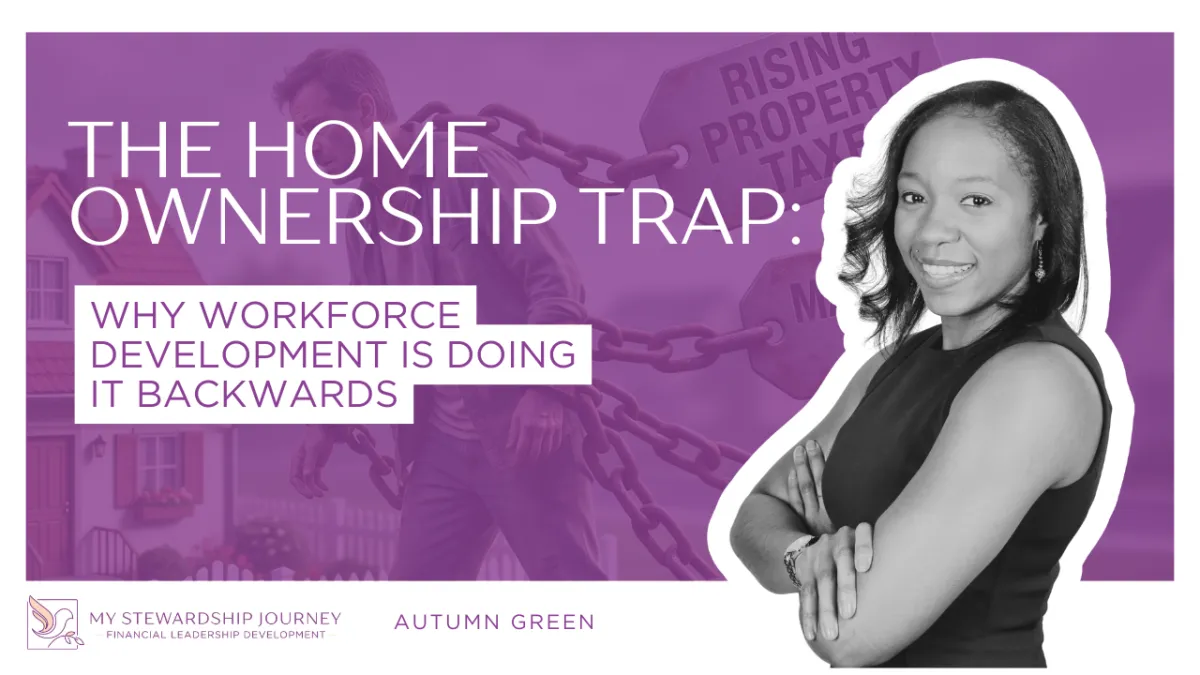
The Homeownership Trap: Why You’re Doing It Backwards
The Homeownership Trap: Why Workforce Development is Doing It Backwards
To my colleagues and leaders in the Workforce Development space: We need to have a serious talk about our "Finish Line."
For decades, we’ve been told that a home is the ultimate indicator of economic mobility. We celebrate the "closing day" as the pinnacle of success. If we aren't careful, we are celebrating the moment our clients become "house-rich and cash-poor."
I’m going to be direct: Homeownership is maybe an indicator of stability. Having a roof is not an indicator of success in and of itself. If your programs aren't peeling back the layers to examine cash flow, debt-to-income ratios, and opportunity costs, you might be helping your clients acquire a liability in disguise.
The Reality Check: When we push homeownership before a Financial Operating System is in place, we are skipping steps and setting people up for financial ruin.
1. Math Must Lead the Mission
I’m writing this as a homeowner. But I didn’t buy my home because I thought it would finally make me "financially successful." I didn't wait for a "livable wage" and then run to a Realtor.
Before I even looked at a listing, my personal Financial Operating System was already bulletproof. I had a budget I consistently executed. I eliminated high-interest debt. I maxed out my Roth IRA and my 401(k) match. I had ample savings and discretionary income left over. I chose to purchase a home because the math—the interest rates vs. market rent—was favorable for my specific cash flow.
My home didn’t drain my wealth because my cash flow was already protected.
Ask yourself: Are your programs teaching clients how to build a bulletproof system first, or are you just rushing them toward a mortgage the moment their income hits a certain threshold? If it’s the latter, you’re skipping the foundation.
2. The "Backwards" Approach to Economic Mobility
The problem is that our current industry narrative tells people that buying a home is how you start building wealth. We encourage people to jump into a 30-year obligation before they have the systems in place to protect their income.
The result? They buy the home, and suddenly 60% of their paycheck is gone before they even hit the grocery store. Their cash flow isn't just tied up; it's strangled. They’ve traded their liquidity—their ability to pivot, invest, and breathe—for a pile of bricks.
It’s backwards as hell. You don’t buy a primary home to get rich; you buy a home because you’ve built a system—like the Payday Paradigm™—that allows you to afford the luxury of owning your shelter without compromising your independence.
The Reality Check: If your clients are "successful" homeowners who can't afford a $1,000 emergency because their mortgage is too high, you haven't moved them toward mobility. You've moved them into a trap.
3. The "House Hacking" Exception
If you are teaching "House Hacking"—purchasing a multifamily property where rental income covers the mortgage and creates positive cash flow—then that's an exception,
For the average person buying a single-family home just to "stop paying rent"? That’s consumption, not an investment strategy. We need to know the difference.
4. Cash Flow is the Only Real Metric
In the financial leadership space, we don't measure success by "Assets Owned." We measure success by whether a person is on track toward Financial Independence.
Financial Independence means amassing enough invested capital that your money generates a return passively while you sleep. We shouldn't be after asset acquisition; we should be after cash flow creation. If a client's money isn't working for them, they are always going to be dependent on exchanging their time for a paycheck. And we know that eventually, that exchange ends.
Do they have the luxury of choice?
Can they pursue a passion project or go back to school?
Can they be there for their family without checking a PTO balance?
They cannot have those luxuries if their cash flow is buried in their backyard.
5. Raising the Bar for 2026
We have to stop using outdated metrics to measure success today. Homeownership is a fraction of the overall picture, and it’s often the most illiquid, burdened fraction.
Our goal as Workforce Development leaders shouldn't be to "get people into homes." Our goal should be to get people into Financial Operating Systems. Let’s teach them to protect their cash flow first. Let’s teach them to build systems that produce income in their sleep. Then, and only then, if the math makes sense, let them buy the house. Success isn’t the roof over their head; success is the freedom in their bank account. Let’s stop skipping the steps.